
Watching a toddler struggle to communicate can be heartbreaking and frustrating at the same time. When a child knows what they want but can’t express it, everyday moments like snack time, playtime, or bedtime can quickly turn into meltdowns. This is where AAC apps for toddlers can be truly life changing. These tools give young children a way to communicate using pictures, symbols, and simple words long before speech fully develops. Today, AAC apps for toddlers are no longer seen as a last option. In 2025, early communication support is widely recommended by speech therapists, pediatricians, and early intervention specialists. Parents are using AAC not only to support speech delays but also to encourage interaction, independence, and confidence. When introduced early and used consistently, AAC becomes part of a child’s natural communication journey rather than a temporary fix.
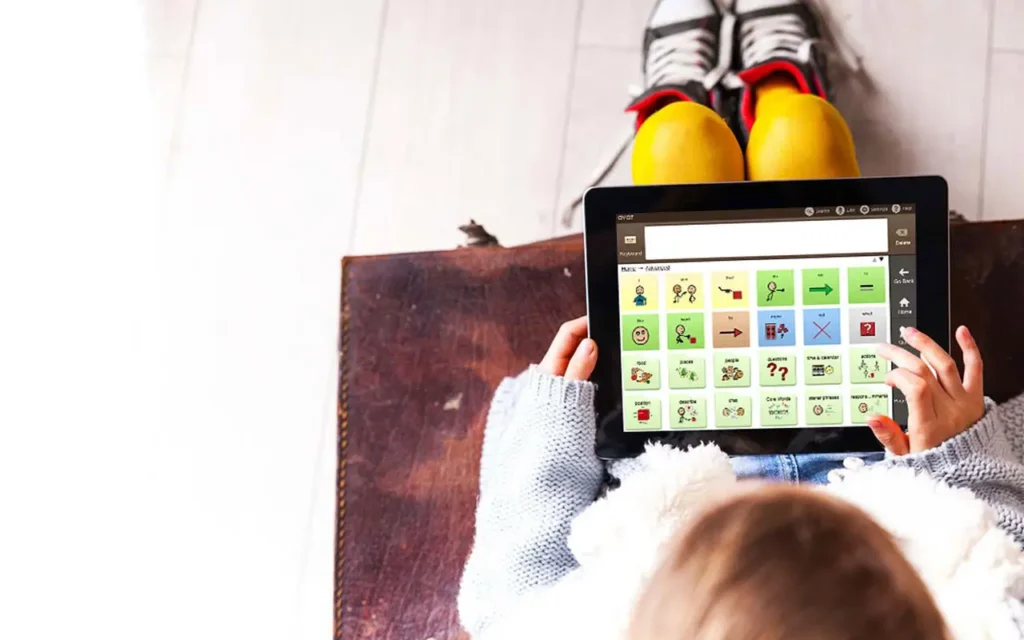
AAC apps for toddlers are built with one clear goal in mind: helping young children communicate in a way that feels easy and natural. Toddlers don’t need complex language systems or crowded screens. They need simple layouts, large icons, and words that match their everyday experiences like eating, playing, and asking for help. The most effective AAC apps for toddlers focus on communication success, not perfection. In recent years, AAC technology has evolved significantly. Many modern apps now support customization, real photos, motor planning approaches, and family-friendly interfaces. These features allow AAC to grow with the child instead of being replaced every year. When chosen carefully, AAC apps for toddlers can support early language development while reducing frustration and encouraging meaningful interaction.
Table of Contents
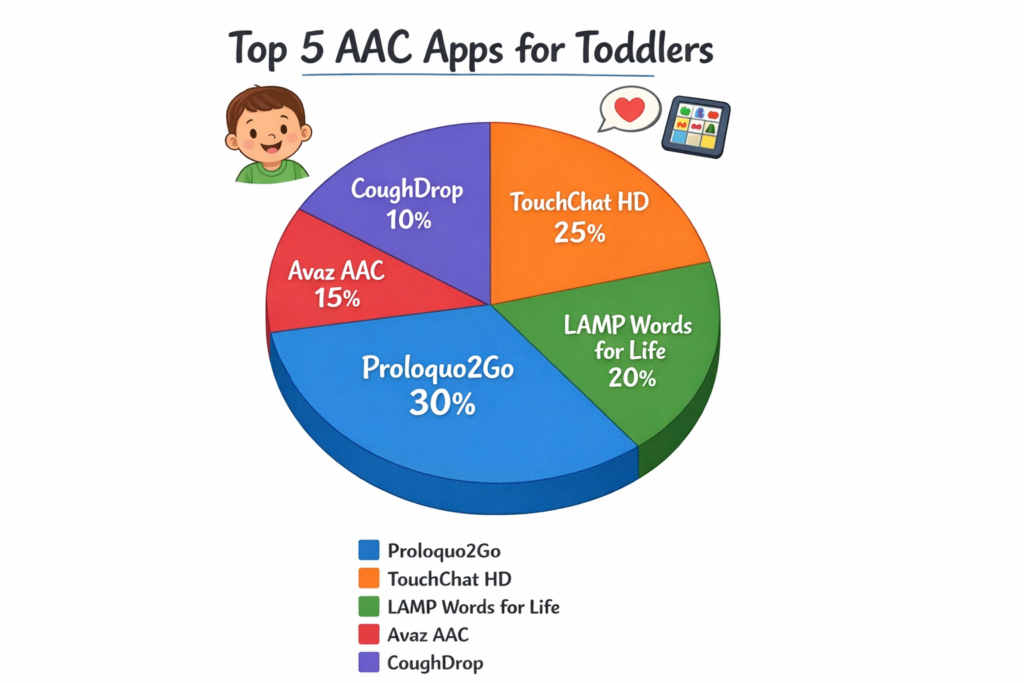
Top 5 AAC (Augmentative Communication) Apps
| App Name | Platform | Best For | Key Features | Pricing |
|---|---|---|---|---|
| Proloquo2Go | iOS | Long-term language growth | Symbol-based communication, customizable layouts | One-time purchase |
| TouchChat HD | iOS | Structured language learning | WordPower vocabulary, flexible grids | One-time purchase |
| LAMP Words for Life | iOS | Motor planning approach | Consistent icon placement, predictable navigation | One-time purchase |
| Avaz AAC | iOS, Android | Early communicators | Child-friendly visuals, quick customization | One-time purchase |
| CoughDrop | iOS, Android, Web | Multi-device use | Cloud-based boards, easy sharing | Subscription |
AAC apps for toddlers are powerful tools that open doors to communication when speech is still developing. They help children express needs, share feelings, and engage with the world around them. Used early, AAC can reduce frustration and build strong foundations for language and social interaction. Every toddler’s communication journey looks different. Progress may be slow at times, but consistency and support make a lasting difference. With the right app and a supportive environment, AAC apps for toddlers can help children feel heard, understood, and confident in their ability to communicate.
Proloquo2Go
- Proloquo2Go is one of the most widely used AAC apps and is often recommended by speech-language pathologists. While it’s suitable for users of all ages, it can be easily adapted for toddlers by simplifying the layout and limiting vocabulary. Parents can start with a small set of essential words such as “more,” “eat,” “help,” or “play.”
- What makes Proloquo2Go stand out among AAC apps for toddlers is its flexibility. The app allows caregivers to hide buttons, adjust grid size, and add personalized vocabulary as the child grows. This gradual expansion helps toddlers feel successful early on while supporting long-term communication development. It’s a strong option for families looking for a tool that won’t need to be replaced as skills improve.
TouchChat HD
- TouchChat HD is known for its structured approach to communication. It uses vocabulary systems designed to support language learning through consistent word placement and repetition. For toddlers, caregivers usually create simplified pages that focus on core words and basic needs.
- One of the biggest advantages of TouchChat HD is how well it supports modeling. Adults can easily use the app alongside the child, showing them how to select words during real-life activities. Among AAC apps for toddlers, TouchChat HD works especially well for families who value structure and routine in early language learning.
Lamp Words for Life
- LAMP Words For Life is based on a motor planning approach to communication. Instead of relying on visual scanning alone, children learn where words are by repeating the same movements each time. This consistency can be helpful even for very young users when the vocabulary is reduced appropriately.
- For toddlers, the app is often introduced with a limited number of words to avoid overload. Over time, as the child becomes more comfortable, additional vocabulary can be unlocked. Families who choose LAMP often do so because they want an AAC system that supports predictable language development over many years.
Avaz AAC
- Avaz AAC is especially popular with younger children because of its bright visuals and intuitive design. It feels more like a playful learning tool than a clinical therapy app, which helps toddlers engage more willingly. Parents can quickly add or remove words based on daily routines and interests.
- Among AAC apps for toddlers, Avaz AAC is often praised for how quickly children respond to it. The ability to use real photos instead of symbols makes it easier for toddlers to connect words with familiar people, foods, and toys. This can be especially helpful during the earliest stages of AAC use.
Coughdrop
CoughDrop is a cloud-based AAC app that works across phones, tablets, and computers. This makes it ideal for families who want consistent communication tools at home, daycare, and therapy sessions. Caregivers can create simple boards for toddlers and update them in real time as needs change. The subscription pricing model makes CoughDrop accessible for families who prefer lower upfront costs. Among AAC apps for toddlers, it stands out for its flexibility and ease of collaboration. Parents, teachers, and therapists can all work from the same communication system without duplicating effort.
How To Choose the Right AAC App for Your Toddler
Choosing between AAC apps for toddlers doesn’t mean picking the most advanced option. The best app is the one your child will actually use. Toddlers benefit from apps with large buttons, clear images, and limited choices. Too many words too soon can slow progress and increase frustration. It’s also important to think about who will support the child during AAC use. Apps work best when adults model language consistently during everyday activities. Many families find it helpful to consult a speech-language pathologist for guidance, but parents can successfully introduce AAC at home with patience and consistency.
Tips For Introducing Aac At Home
- Start slow. Introduce AAC during moments your toddler is already motivated to communicate, such as snack time or playtime. Use the app yourself to model words instead of expecting your child to use it perfectly right away.
- Keep AAC visible and accessible throughout the day. The more opportunities a toddler has to see and use the app, the more natural it becomes. Remember that AAC apps for toddlers are tools for connection, not tests of performance.
FAQs on Augmentative Communication
Are AAC apps for toddlers safe to use daily
Yes, AAC apps are designed for regular use and can be safely used throughout the day as part of normal routines.
Will AAC prevent my toddler from learning to speak
No. Research shows AAC supports communication and often encourages speech development rather than replacing it.
How many words should an AAC app have for a toddler
Starting with a small number of functional words is best. Five to ten words is often enough at the beginning.
Do AAC apps for toddlers require professional training
Professional guidance helps, but parents can successfully use AAC apps at home with simple modeling and consistency.