

Coaching has moved from being a “nice to have” perk to a serious business strategy. Companies today use coaching to improve leadership skills, strengthen teams, and prepare people for bigger roles. As this demand grows, organizations often face one key decision early on: should they rely on internal coaches or hire external ones?

Understanding the real difference between these two options can save time, money, and frustration while delivering better results. The discussion around internal vs. external coaches is not about which one is better overall. It is about which one fits a specific goal, team, or situation. Both play important roles in modern workplaces, but they work in very different ways. Knowing those differences helps leaders make smarter, more strategic choices.
When people talk about internal vs. external coaches, they are really comparing proximity and perspective. Internal coaches are employees of the organization who are trained to coach others. External coaches are independent professionals brought in from outside the company. That single difference affects trust, objectivity, cost, and impact. Internal coaching is often used to support long-term development and reinforce company culture. External coaching is commonly chosen for leadership transitions, executive growth, or sensitive challenges where neutrality matters most. Many organizations eventually realize that the smartest approach is not choosing one over the other, but knowing when to use each.
Table of Contents
Internal vs. External Coaches
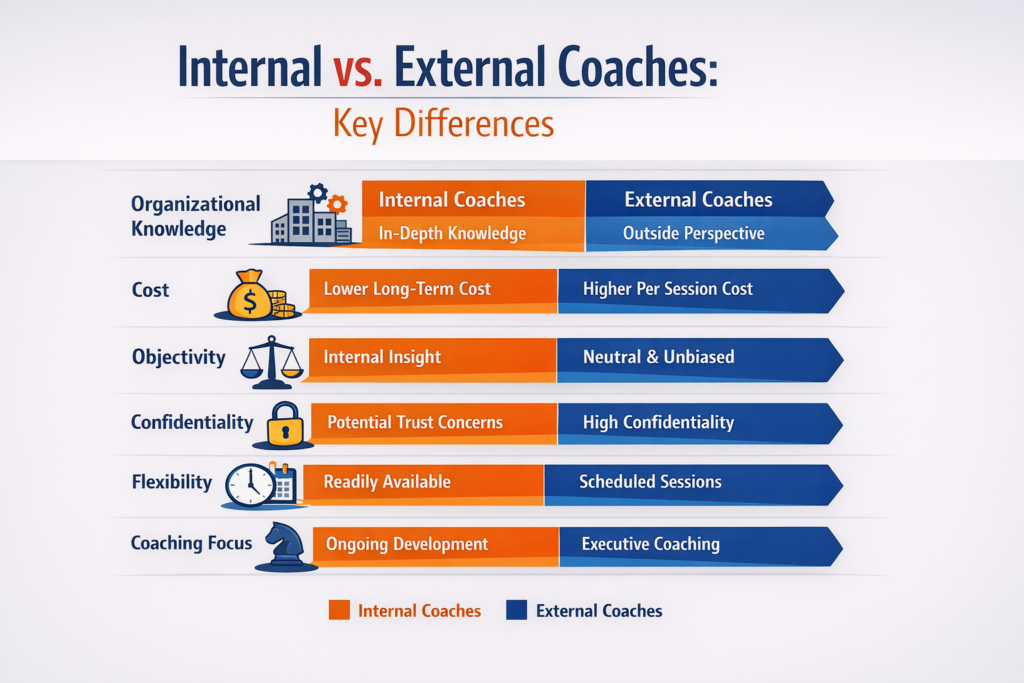
| Area | Internal Coaches | External Coaches |
|---|---|---|
| Role In Organization | Employees with coaching training | Independent professionals |
| Knowledge Of Company | Immediate and deep | Built over time |
| Objectivity Level | Moderate | High |
| Cost Model | Lower long-term cost | Higher short-term cost |
| Confidentiality Perception | Sometimes cautious | Strong |
| Typical Use Cases | Ongoing development | Executive and complex coaching |
The real value of coaching comes from using the right approach in the right context. Understanding internal vs. external coaches allows organizations to move beyond preference and make strategic decisions that support both people and performance. Internal coaches offer continuity, cultural alignment, and cost efficiency. External coaches bring objectivity, fresh insight, and credibility at senior levels. When used thoughtfully, both models can coexist and complement each other, creating a stronger and more effective coaching strategy overall.
Who Are Internal Coaches?
Internal coaches are people already working inside the organization who have received formal coaching training. They may come from HR, learning and development, or leadership roles. Their main advantage is familiarity. They understand how the organization works, what the culture values, and where the pressure points are. Because they know the system so well, internal coaches can align coaching conversations with business goals. They help employees develop skills that matter immediately and support behaviors the organization wants to encourage. Internal coaching is especially effective for manager development, team coaching, and leadership pipelines. However, internal coaches must manage boundaries carefully. In the internal vs. external coaches discussion, trust is often the biggest challenge for internal coaching. Employees may worry about how confidential conversations truly are, especially if the coach has influence or visibility within the organization. Clear role separation and strong ethical standards are essential.
Who Are External Coaches?
- External coaches are professional coaches who are not employed by the organization. They are usually hired for a specific period or purpose, such as executive coaching, leadership transitions, or organizational change. External coaches bring experience from working with many different companies and leaders.
- One of their biggest strengths is objectivity. External coaches are not part of internal politics or reporting structures. This allows them to ask difficult questions, challenge assumptions, and provide honest feedback without bias. For senior leaders, this outside perspective is often invaluable.
- In the internal vs. external coaches comparison, external coaches are often preferred for sensitive situations. Leaders tend to open up more easily when they know the coach has no stake in internal outcomes. The main downsides are higher costs and the time required for the coach to understand the organization’s context.
Cost And Resource Considerations
- Cost is one of the most practical factors when evaluating internal vs. external coaches. Internal coaching programs require upfront investment in training and certification. Once established, however, they become highly cost effective. A small group of trained internal coaches can support many employees over time.
- External coaches usually charge per session or engagement. This makes them more expensive in the short term, especially for large populations. However, organizations often see strong returns when external coaches work with senior leaders whose decisions have wide-reaching impact.
- Many companies adopt a hybrid approach. Internal coaches handle broad development needs, while external coaches are brought in for high-stakes or specialized situations. This balance helps control costs while maximizing impact.
Confidentiality And Trust
Trust is the foundation of effective coaching. In the internal vs. external coaches debate, confidentiality is often where the difference becomes most visible. Even with clear confidentiality agreements, internal coaches may be perceived as less neutral because they are part of the organization. External coaches benefit from distance. Leaders often feel safer discussing doubts, conflicts, or personal challenges with someone outside the system. This sense of safety can lead to deeper conversations and faster progress. Organizations that rely heavily on internal coaching must communicate clearly about confidentiality boundaries. Separating coaching from performance evaluation is critical to building trust and encouraging openness.
Impact On Organizational Culture
- Internal coaching has a powerful influence on culture. Because internal coaches are embedded in the organization, they reinforce shared values, leadership behaviors, and communication styles. Over time, this can create a culture where feedback, reflection, and growth are part of everyday work.
- External coaches influence culture differently. They bring in fresh ideas and challenge long-held assumptions. In the internal vs. external coaches discussion, this outside influence is especially valuable during periods of change, growth, or transformation.
- Organizations with mature learning cultures often use both. Internal coaches sustain the culture, while external coaches help push it forward.
Flexibility And Accessibility
- Internal coaches are generally more accessible. They can offer regular sessions, informal check-ins, and ongoing support. This makes them ideal for long-term development and continuous learning.
- External coaches work within defined contracts and schedules. While this limits flexibility, it also creates structure. Sessions are often highly focused, with clear goals and outcomes.
- When considering internal vs. external coaches, organizations should think about whether they need ongoing support or targeted intervention. Each model serves a different rhythm of development.
Skill Development and Consistency
Internal coaches provide consistency. Because they work within the same framework, they reinforce common language and leadership models across the organization. This consistency is valuable for building shared understanding and aligned behaviors. External coaches offer breadth. Their exposure to different industries and leadership styles allows them to introduce new tools and perspectives. In the internal vs. external coaches comparison, this diversity of experience is one of the strongest advantages of external coaching. Using both allows organizations to balance consistency with innovation.
Choosing The Right Coaching Approach
There is no one-size-fits-all answer to the internal vs. external coaches question. The right choice depends on factors such as organizational size, leadership maturity, budget, and the nature of the coaching need. Internal coaches work best for scalable development, leadership pipelines, and culture building. External coaches are ideal for executives, complex challenges, and moments that require complete neutrality. Organizations that are clear about their goals are better equipped to choose the right coaching model at the right time.
FAQs on Internal vs. External Coaches
What Is the Main Difference Between Internal And External Coaches?
Internal coaches are employees of the organization, while external coaches are independent professionals hired from outside.
Are Internal Coaches More Cost Effective?
They are usually more cost effective for long-term and large-scale development, while external coaches are better for targeted, high-impact roles.
Do Leaders Prefer External Coaches?
Many senior leaders prefer external coaches due to neutrality and confidentiality, especially for sensitive topics.
Can An Organization Use Both Coaching Models?
Yes, many organizations successfully use a blended approach that combines internal and external coaching.