

Practice-Based Coaching (PBC), an evidence-informed professional development framework centered on real-world practice and continuous feedback, is increasingly shaping how educators improve instruction across early childhood and K–12 settings. Built around a structured three-step coaching cycle, the model aims to bridge the long-standing gap between research-based strategies and day-to-day professional practice, according to federal education agencies and academic researchers.
Table of Contents
What Is Practice-Based Coaching (PBC)?
Practice-Based Coaching (PBC) is a structured professional development approach designed to support practitioners as they implement evidence-based practices in authentic work settings. Unlike traditional training models that rely heavily on workshops or lectures, PBC focuses on what professionals actually do in their daily roles and how those practices can be improved over time.
The framework was developed and promoted by the U.S. Office of Head Start, under the Administration for Children and Families, in response to growing evidence that stand-alone training rarely leads to sustained changes in professional behavior. Federal guidance describes PBC as a collaborative, non-evaluative process grounded in mutual trust, shared responsibility, and data-informed reflection.
“Practice-Based Coaching is about supporting adults in using effective practices consistently and intentionally,” the Office of Head Start states in its published framework. “It is not supervision, and it is not an evaluation.”
Although PBC is most commonly associated with early childhood education, its principles have influenced coaching models in K–12 schools, healthcare, and social service agencies, where professionals face similar challenges translating research into practice.
Why Traditional Professional Development Often Falls Short
For decades, professional development in education has been dominated by workshops, conferences, and one-time training sessions. While these formats can raise awareness, multiple studies have found they rarely change long-term behavior.
A review of professional learning research cited by the Institute of Education Sciences found that without follow-up support, fewer than 20 percent of participants implement new strategies consistently. Time constraints, lack of feedback, and limited opportunities for reflection are among the most frequently cited barriers.
Practice-Based Coaching (PBC) emerged as a response to these limitations. By embedding learning directly into the workplace and tying it to observable practice, the model aims to produce deeper and more durable change.
The 3-Step Practice-Based Coaching (PBC) Cycle
At the core of Practice-Based Coaching is a continuous, three-step improvement cycle. Each step is designed to build on the previous one, creating a feedback loop that supports growth over time.
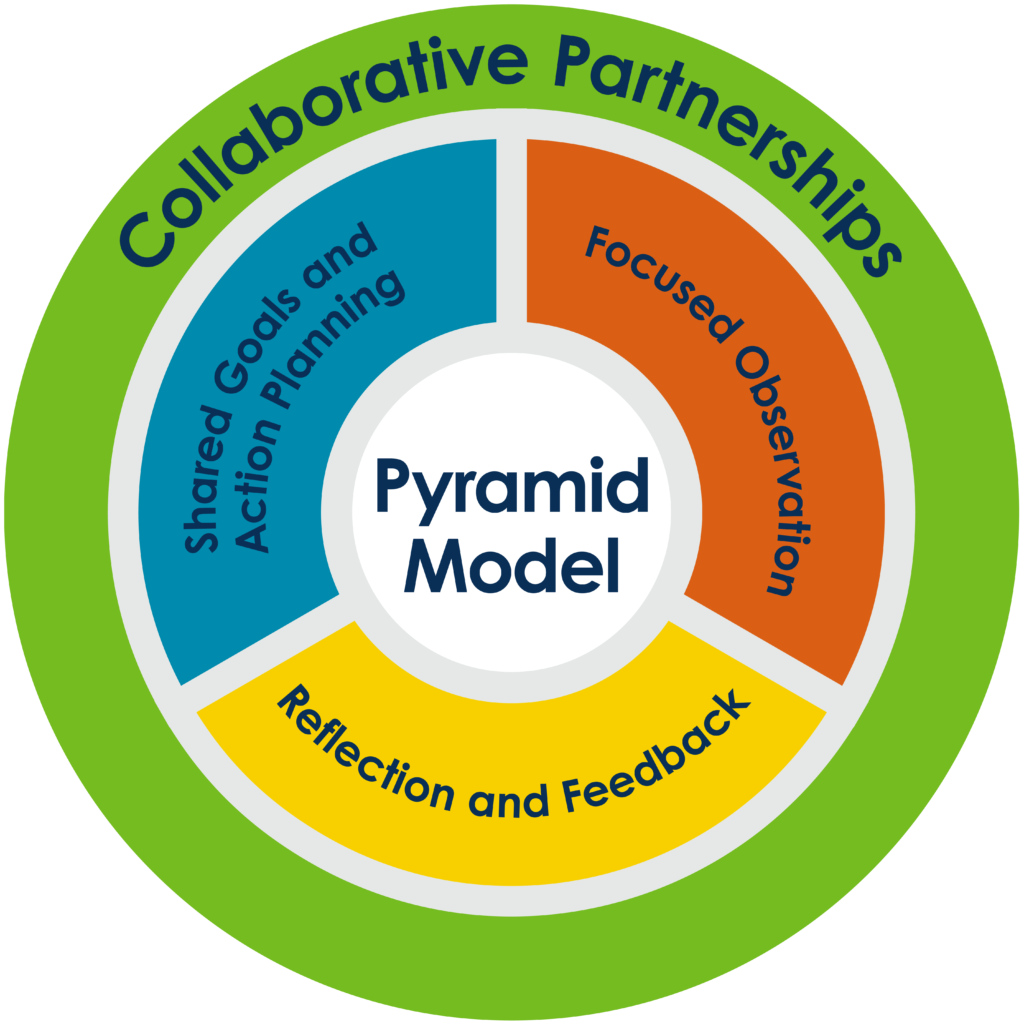
Step 1: Shared Goals and Action Planning
The coaching process begins with collaborative goal setting. Coaches and practitioners work together to identify specific practices to strengthen, using data such as classroom observations, child outcomes, or program priorities.
Goals are intentionally narrow and measurable. Rather than broad objectives like “improve classroom management,” PBC goals focus on observable behaviors, such as increasing the use of open-ended questions or providing more consistent feedback to learners.
Action plans outline how the practitioner will work toward the goal, including when and how strategies will be practiced, what supports are needed, and how progress will be monitored.
“Clear, shared goals are the anchor of effective coaching,” said Dr. Gail Joseph, a professor of special education at the University of Washington. “When goals are concrete and co-developed, practitioners are more likely to see coaching as relevant and supportive.”
Step 2: Focused Observation
In the second step, the coach observes the practitioner implementing the agreed-upon strategies in real time. Observations may occur in person or through video recordings, depending on program resources and privacy considerations.
The observation is intentionally focused. Coaches collect data only on the specific practices identified in the action plan, reducing subjectivity and ensuring feedback is grounded in evidence rather than general impressions.
This approach distinguishes PBC from informal walkthroughs or evaluations. The purpose is not to judge performance, but to gather information that can support meaningful reflection.
Step 3: Reflection and Feedback
Following the observation, the coach and practitioner engage in a structured reflection and feedback session. The conversation typically begins with the practitioner reflecting on what worked, what felt challenging, and how the strategies aligned with their goals.
The coach then shares feedback based on observation data, highlighting strengths and offering targeted suggestions for refinement. Together, they decide whether to continue with the same goal, revise the action plan, or move on to a new focus area.
According to a synthesis of coaching research published by the National Center on Early Childhood Development, Teaching, and Learning, reflective feedback is a critical factor in sustained improvements in professional practice.
Evidence of Effectiveness
A growing body of research supports the effectiveness of Practice-Based Coaching (PBC), particularly in early childhood education. Studies have linked coaching-based professional development to improvements in instructional quality, teacher confidence, and child outcomes.
Federal evaluations of Head Start programs have found that sites implementing PBC with fidelity show stronger gains in classroom interactions compared with programs relying solely on traditional training methods.
Researchers caution, however, that outcomes depend heavily on implementation quality. Coaching that lacks clear goals, consistent observation, or reflective dialogue is less likely to produce meaningful change.
Implementation Challenges and Resource Demands
Despite its benefits, Practice-Based Coaching is resource-intensive. Programs must invest in training qualified coaches, allocating time for observations and feedback sessions, and maintaining manageable coach-to-practitioner ratios.
Smaller programs and under-resourced districts often struggle to implement PBC at scale. Scheduling constraints, staff turnover, and competing priorities can also disrupt coaching cycles.
“Practice-Based Coaching is not a quick fix,” said Dr. Bridget Hamre, a senior researcher at the University of Virginia’s Curry School of Education. “It requires sustained commitment, protected time, and leadership support to be effective.”
Maintaining Trust and Avoiding Evaluation Confusion
One of the most frequently cited risks in implementing PBC is confusion between coaching and evaluation. Experts emphasize that trust is foundational to the model.
Federal guidance stresses that coaches should not serve as evaluators, and observation data collected during coaching should not be used for personnel decisions. When practitioners fear judgment, they are less likely to take risks or engage honestly in reflection.
Clear communication, written protocols, and leadership buy-in are often cited as essential safeguards.
Practice-Based Coaching (PBC) Beyond Early Childhood
While PBC originated in early childhood education, its principles have influenced professional learning in other sectors. School districts have adapted the cycle for instructional coaching in K–12 classrooms, while healthcare systems have applied similar models to improve clinical practice.
International development organizations have also explored coaching-based approaches in teacher training programs, particularly in low-resource settings where ongoing support is critical.
Policy Context and Federal Support
Practice-Based Coaching (PBC) is embedded in federal performance standards for Head Start and is referenced in guidance from multiple U.S. education agencies. Funding streams increasingly encourage coaching-based professional development as part of quality improvement efforts.
Policymakers view PBC as a way to maximize the impact of public investment by ensuring that evidence-based practices are not only taught, but used consistently.
Looking Ahead
As education systems face workforce shortages, rising accountability demands, and growing emphasis on evidence-based practice, experts expect Practice-Based Coaching (PBC) to play an expanding role in professional development.
Ongoing research is examining how technology, such as video coaching platforms, can make the model more scalable while preserving its core principles. At the same time, scholars continue to study how coaching quality influences outcomes across diverse contexts.
“Practice-Based Coaching is fundamentally about learning in action,” Dr. Joseph said. “When done well, it creates the conditions for real, lasting improvement.”
FAQs About Practice-Based Coaching
Is Practice-Based Coaching (PBC) the same as mentoring?
No. PBC is a structured, data-driven process focused on specific practices, while mentoring is often broader and less formal.
Who typically uses Practice-Based Coaching (PBC)?
PBC is most common in early childhood education but is increasingly used in K–12 schools and other professional fields.
Is Practice-Based Coaching (PBC) evaluative?
No. According to federal guidance, PBC is designed for professional growth, not performance evaluation.