Government Admits E20 Fuel Can Reduce Mileage by 3–5% in Some Vehicles, Defends Ethanol Blending
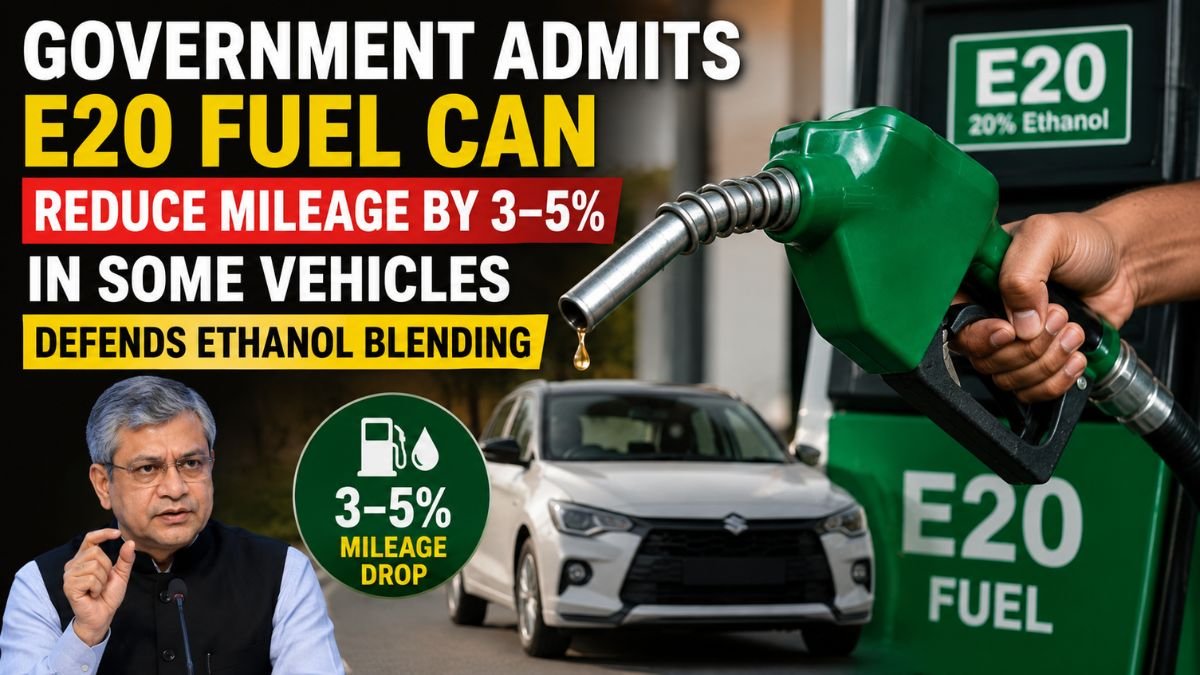
India is rapidly advancing its policy of blending ethanol with petrol. As part of this initiative, E20 fuel—a blend of 20% ethanol and 80% petrol—is being rolled out across the country in a phased manner. Recently, the government acknowledged that using E20 fuel could result in a mileage reduction of approximately 3% to 5% in certain vehicles. However, the government maintains that the benefits of E20 fuel far outweigh this minor drawback.
What exactly is E20 fuel?
E20 fuel is a blend consisting of 20% ethanol and 80% petrol. Ethanol is primarily produced from sugarcane, maize, and other agricultural products. The objective is to reduce dependence on petrol and minimize environmental damage. The Government of India has been working on an ethanol blending program for several years to cut down on the expenditure incurred on importing crude oil.
What has the government acknowledged regarding mileage?
The government has clarified that mileage could drop by 3% to 5% in some vehicles using E20 fuel. The primary reason for this is that ethanol has a slightly lower energy content compared to regular petrol; consequently, the engine may require slightly more fuel to cover the same distance. However, this impact will not be uniform across all vehicles.
Will this affect every vehicle?
No. Not all vehicles will experience a drop in mileage. In vehicles with engines specifically designed for E20 fuel, the impact may be minimal or almost negligible. Conversely, older models or vehicles not engineered for E20 might show a more noticeable difference. Therefore, it is crucial to follow the guidelines provided by the vehicle manufacturer.
Why is the government promoting E20 fuel despite this?
The government believes that E20 fuel is not merely a matter of mileage; it is also linked to the country's energy security. India imports a significant portion of its oil requirements. Blending more ethanol into petrol would reduce dependence on foreign oil. In the long run, this could lower the country's import bill and boost self-reliance in the energy sector.
How beneficial is it for the environment?
Environmental conservation is considered a major benefit of E20 fuel. Ethanol is a renewable fuel, and its use can help reduce carbon emissions. If a large number of vehicles use E20 fuel, there is a strong possibility of reduced pollution. This is why many countries around the world are promoting ethanol-blended fuel.
How will farmers benefit?
Ethanol is produced from sugarcane, maize, and other agricultural crops. Consequently, farmers stand to gain directly from the increased demand. Higher demand creates additional markets for agricultural produce, which can help boost farmers' income. That is why the government views this as a beneficial move for both the agricultural and energy sectors
Should vehicle owners be concerned?
If your vehicle is E20 fuel-compatible, there is no cause for concern. Manufacturers are now introducing new models with engines designed to perform well on E20 fuel. Owners of older vehicles simply need to verify whether their vehicle is suitable for this fuel. It is advisable to consult the manufacturer's service center if necessary.
How much might expenses rise due to reduced mileage?
A 3 to 5 percent drop in mileage does not mean that fuel costs will skyrocket. For instance, if a vehicle previously delivered a mileage of 20 kilometers per liter, using E20 fuel might bring that figure down to approximately 19 to 19.4 kilometers per liter. This difference is not considered significant in daily usage, especially when weighed against major benefits such as energy security and environmental conservation.
What are automobile companies doing?
Almost all major vehicle manufacturers in the country are now developing engines designed to perform optimally with E20 fuel. New engines, fuel systems, and engine management technologies are being engineered to minimize any impact on mileage and performance. In the coming years, most new vehicles will be fully compatible with E20 fuel.
Is E20 fuel the fuel of India's future?
Given the current scenario, it is reasonable to assume that E20 fuel will become a crucial component of India's energy policy. The government aims to promote clean fuel, reduce dependence on imported oil, and create new opportunities for farmers. While a slight reduction in mileage is a reality, the government believes that the long-term economic and environmental benefits far outweigh this drawback.
Conclusion
The government's acknowledgment of a potential 3 to 5 percent drop in mileage with E20 fuel can be seen as a sign of transparency. However, this reduction may be limited to certain vehicles, and the impact is expected to be minimal in new E20-compatible vehicles. On the other hand, ethanol blending is linked to several major objectives, such as reducing the country's oil imports, curbing pollution, and boosting farmers' income.
Related News